Why Joomla deserves to be the best CMS choice for corporate and business projects—and beyond

- Joomla
- October 13, 2026
Table of contents
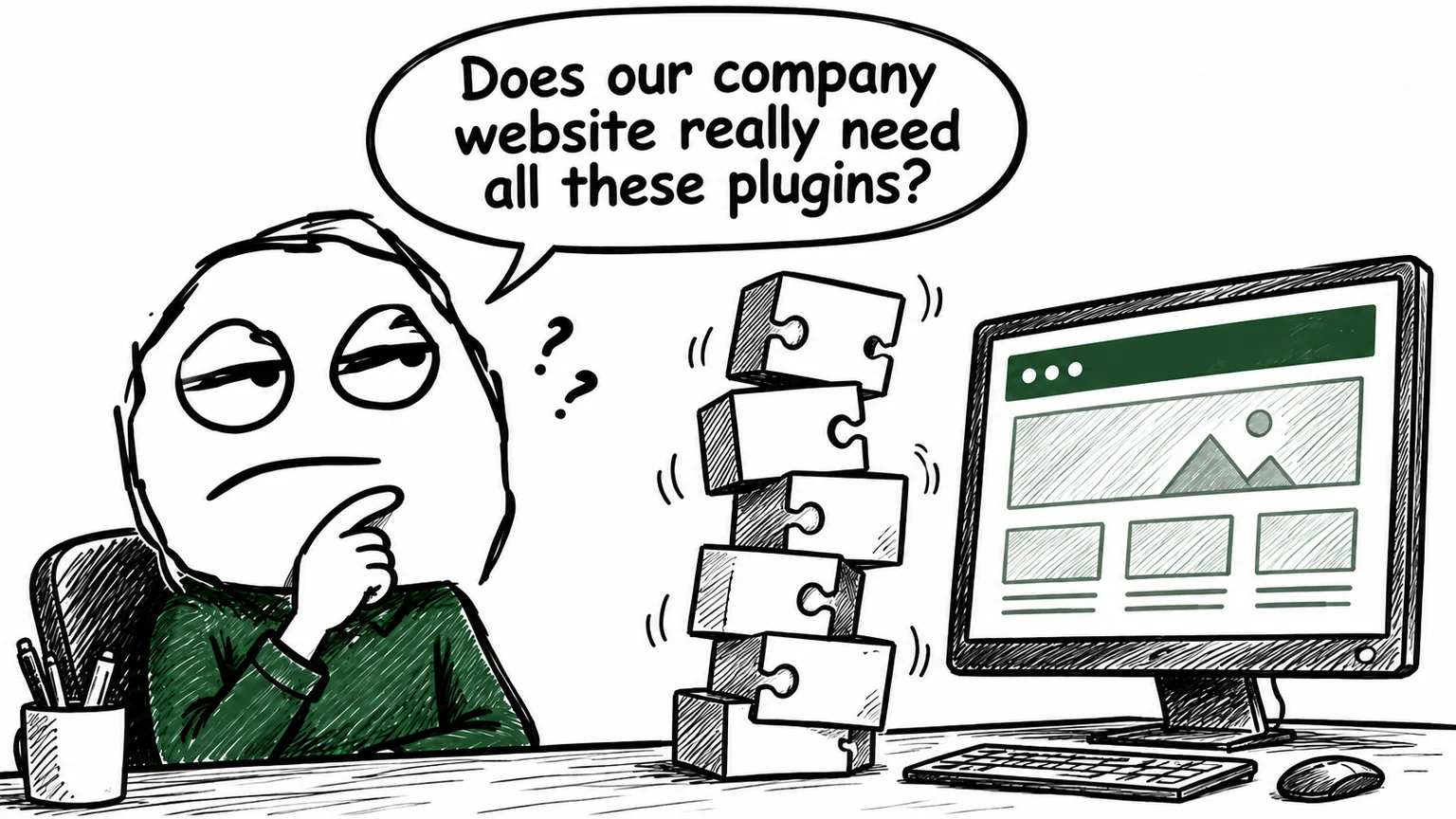
A business website needs to let different people update content, publish in multiple languages and manage restricted information without becoming a collection of plugins that is difficult to maintain. Joomla deserves consideration as a first choice when these requirements shape the project, because the platform already provides tools that might otherwise need extensions or custom development.
Calling it the best CMS for corporate projects is a design position: a preference for particular requirements, rather than a universal ranking. Its strengths become clearer when a website grows beyond presentation pages and needs a manageable editorial structure.
Why Joomla is a strong choice for business websites
Joomla provides a foundation for organising content, access and navigation. A corporate website might contain services, office locations, announcements, technical information and restricted sections. Treating all of these as pages to design can conceal the work needed to manage them.
Content can be managed separately from its menu placement and the modules displayed around it. This takes planning, but provides useful tools as sections and responsibilities expand.
The case for reconsidering Joomla concerns the habit of recommending one CMS for every project. It does not establish a measured comeback or market leadership. What matters to the business is whether the platform supports its processes and can be maintained over time.
WordPress security: plugins and themes can provide entry points
A vulnerable plugin can compromise a website even if the WordPress core is up to date. A theme containing insecure code can introduce similar problems. A function exposed without adequate checks may allow someone to perform an action they should not be authorised to perform.
SQL injection involves unsafe handling of data in database queries. Cross-site scripting, or XSS, can introduce scripts into pages people view. These differ from arbitrary file uploads and missing permission checks, but each can create an attack path.
WordPress’s official documentation addresses these vulnerabilities and calls for updates to the core, plugins and themes. Assessing security therefore means examining the whole installation: what runs code, who maintains it and how quickly fixes are applied.
Observing compromised websites does not establish that attacks are continually increasing or that WordPress is inherently insecure. That would require comparable data over time. Depending on abandoned or unpatched extensions is a concrete risk that can be investigated without making that broader claim.
Joomla security and stability: fewer dependencies where the core fits
Joomla can reduce the need for extensions when built-in tools cover a project’s requirements. That can simplify the dependency inventory and compatibility checks. It is an operational advantage, rather than a guarantee that having fewer components automatically makes a website secure.
Joomla also has vulnerabilities, third-party extensions and templates that require updates. Stability depends on a supported release, a compatible environment and checks before changes reach production. A website can still load normally while being exposed to an attack.
For a business installation, I would plan for:
- individual accounts with only the privileges needed for each role;
- multi-factor authentication for sensitive access;
- updates and a review of extensions actually in use;
- backups stored separately from the website, with restoration tests;
- staging tests covering updates, forms and restricted functions.
For an existing installation, Joomla website support starts with examining the website and its dependencies.
Granular permissions for departments and restricted content
Joomla’s access control system distinguishes who can view content from who can change it or perform an action. User groups, viewing access levels and permissions allow responsibilities to be defined more precisely than simply giving everyone administrator access.
Consider a proposed workflow in which sales staff update selected information, communications staff prepare announcements and a manager authorises publication. The rules need configuration and testing with representative accounts. Creating differently named groups does not prove that their access is correctly separated.
This makes Joomla worth considering for businesses with several contributors, associations and document portals. Restricted areas also need checks on direct file access: hiding a document’s link does not automatically protect the file itself.
Built-in multilingual tools for international websites
Joomla includes tools for content languages and associations between corresponding items. This is a useful starting point for a corporate website that needs coherent versions of its pages and navigation.
Built-in support does not translate announcements, product information or service descriptions automatically. The project still needs decisions about what to localise, who maintains it and what happens when a page has no equivalent in another language.
Compared with a WordPress project using a multilingual plugin, the dependency arrangement changes: Joomla provides this capability within the platform. Templates, extensions and URLs still need testing in each language.
Fields, workflows and modules beyond a simple blog
Custom fields help separate recurring information from free-form text. For a service description, a dedicated field might hold information that should appear consistently across several entries. The layout then needs to display it appropriately.
Publishing workflows organise stages of editorial work. Modules provide reusable content blocks, while template overrides allow output to be customised without directly changing the core.
These tools support an orderly website, but require knowledge of the platform. An override remains code that needs maintenance and checks after updates. For a practical example of reusable blocks, read about creating a Joomla module with YOOtheme Builder.
When a developer recommends WordPress without assessing Joomla
Someone who only knows WordPress may recommend it because it is the tool they can deliver with. That possibility should be recognised, but it does not show that all newer developers lack Joomla skills or that every WordPress recommendation is wrong.
The supplier’s experience is a legitimate consideration: it affects delivery and maintenance. It becomes a limitation when familiarity is presented as proof that another CMS is unsuitable, without examining the requirements.
Ask which functions will be native, which will depend on extensions and how languages, permissions and updates will be handled. “We always use this platform” does not explain why it fits the business.
The same scrutiny should apply to a Joomla proposal. A capable supplier should explain the architecture, identify dependencies and make maintenance responsibilities clear, rather than relying on a preference for the platform.
Comparing Joomla with WordPress, Drupal and static websites
| Requirement | Why consider Joomla | What to assess |
|---|---|---|
| Multilingual site with several editors | Languages and ACL within the platform | Configuration and training |
| Portal with recurring content structures | Fields, categories and modules | Whether the content model fits |
| Website built around a particular WordPress product | A possible alternative to investigate | Features and costs of the chosen ecosystem |
| Complex editorial application | A foundation worth assessing | Drupal and custom development |
| Mainly informational website | Browser-based content administration | A static platform such as Hugo, where the publishing process fits |
Joomla is not automatically faster, better for SEO or cheaper. Templates, media, queries, hosting and maintenance affect the outcome. For ecommerce and specialist integrations, extension availability and quality can change the decision.
The comparison should cover the operating website, rather than a default installation. A platform with more built-in functions may still need custom work; an extension-based solution may be appropriate if the components are reliable and maintained.
Choosing Joomla for your next business project
The strongest reason to choose Joomla is the match between requirements and available tools. Detailed permissions, multiple languages and structured content management can make it preferable to an installation assembled from separate components.
The official Joomla documentation explains these tools in more detail. For an older website, staying on the platform also requires an upgrade plan: the Joomla 3 to Joomla 6 migration with T3 and Purity III illustrates why dependencies need investigation before proceeding.
If you need to build or reorganise a business website, I can assess its content, access rules, languages and integrations to determine where Joomla provides a suitable foundation and which customisations are actually needed.