ChatGPT Ads: Paid Advertising Is Challenging Google Ads

- Web marketing
- September 1, 2026
Table of contents
ChatGPT now integrates paid advertising
Yes, ChatGPT has started showing paid advertisements. OpenAI began testing ads in the United States on February 9, 2026, for logged-in adults using the Free and Go tiers. It subsequently introduced a self-service Ads Manager, CPC and CPM buying, and expanded the service to additional markets.
This is not just another banner added to another website. It is the creation of an advertising channel that appears while someone is explaining a need, comparing alternatives, and moving towards a decision. That is why ChatGPT Ads is a major digital advertising revolution and a powerful challenge to Google Ads and other advertising platforms.
This does not mean Google Ads is about to disappear. It means Google is no longer the only major intermediary able to connect an explicitly stated intention with a relevant commercial offer.
Updated September 1, 2026: according to OpenAI’s official announcement, ChatGPT Ads is live in the United States, Canada, Australia, New Zealand, the United Kingdom, Mexico, Brazil, Japan, and South Korea. OpenAI says that it intends to keep expanding, but availability is not yet global.
How do ads in ChatGPT work?
ChatGPT ads are selected in relation to the context of a conversation, but they remain clearly labelled as sponsored and visually separate from the organic answer. OpenAI also says that advertising does not alter ChatGPT’s answers and that advertisers do not receive users’ chats, history, memories, or personal details.
During the test, ad selection may consider:
- the topic of the current conversation;
- the user’s previous chats;
- previous interactions with ads;
- the relevance of an ad to the stated need.
Users can turn off personalisation, delete advertising data, dismiss an ad, and see why it was displayed. OpenAI also excludes accounts belonging to minors and restricts advertising near sensitive or regulated conversations. These rules may change as the programme develops; the current reference is OpenAI’s official advertising policy.
Why ChatGPT Ads is an advertising revolution
The real innovation is not the visual format. It is the conversational context. In a search engine, intent is often compressed into a few words such as “hiking boots”, “Rome hotel”, or “SEO consultant”. In ChatGPT, users can explain their goals, budget, preferences, constraints, and doubts over several messages.
This produces a commercial signal that may be considerably richer than a single keyword.
| Traditional search | ChatGPT conversation |
|---|---|
| Short query | Need described in natural language |
| Intent inferred from keywords | Intent clarified through multiple messages |
| Results compared manually | Alternatives already explained and compared |
| Ad placed beside search results | Ad placed near a contextualised decision |
Someone might ask: “Which laptop should I buy with a £1,200 budget if I edit video, travel frequently, and need at least eight hours of battery life?” This is more than a keyword. It contains a budget, use case, mobility requirement, and technical constraint—all of which can make an advertising message more relevant to the real decision.
Why ChatGPT Ads is a serious challenge to Google Ads
Google built a substantial part of its business by capturing search intent. ChatGPT is now entering the same territory through a different interface: not a page of links, but a dialogue that helps a person define a problem and select a solution.
The challenge to Google Ads comes from four changes.
1. Commercial intent is moving from queries to conversations
If some users begin their journey in ChatGPT instead of Google, some advertising opportunities will move with them. The key question is not only where a click happens, but where the decision begins and develops.
2. ChatGPT has access to context expressed by the user
A conversation can reveal far more nuance than a keyword. This does not automatically guarantee better campaigns, but it creates the conditions for highly relevant advertising.
3. OpenAI is building a new advertising market
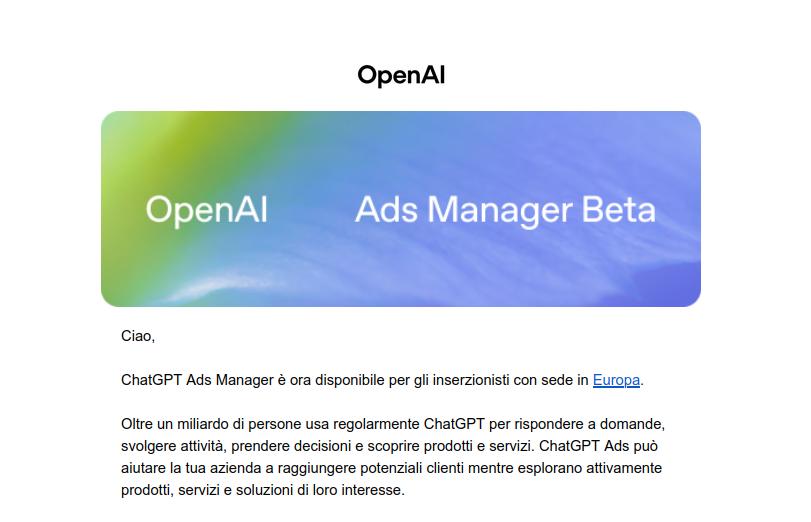
In May 2026, OpenAI announced new ways to buy ChatGPT ads, including a beta Ads Manager, campaign-management partners, expanded measurement, and both CPC and CPM bidding. This is no longer simply a visual experiment; these are the foundations of a standalone advertising platform.
4. The journey from question to action may become shorter
The assistant can guide a user from discovery to comparison. A relevant advertisement presented at that point could reduce the number of steps between interest and a visit to an advertiser’s website. This advantage could grow as OpenAI adds more formats, objectives, and buying models.
Google is not standing still
Calling ChatGPT Ads a threat does not mean underestimating Google. Google has already placed ads in AI Overviews and started testing them in AI Mode. Search, Shopping, Performance Max, and AI Max campaigns can feed these placements, as described in Google’s announcement about advertising in AI-powered Search.
Google retains enormous advantages:
- a mature global advertising network;
- a very large base of advertisers;
- extensive historical conversion data;
- integration with Search, Shopping, YouTube, Maps, and partner websites;
- established measurement and optimisation tools.
The revolution is therefore not “the end of Google Ads”. It is the end of an equilibrium in which paid search had an almost unavoidable centre. Competition is now shifting towards contextual quality, user trust, and the ability to appear at the moment of choice.
ChatGPT Ads vs Google Ads and social advertising
| Platform | Primary signal | Main advantage | Current limitation |
|---|---|---|---|
| ChatGPT Ads | Conversation and context | Rich intent close to a decision | Young platform with limited geographic availability |
| Google Ads | Queries, browsing, and commercial data | Scale, maturity, and reach | Search journey can be more fragmented |
| Meta Ads | Interests and social behaviour | Discovery and strong creative formats | Purchase intent is not always explicit |
| LinkedIn Ads | Professional profile and context | B2B targeting | Often higher costs and lower volume |
| Marketplace Ads | Activity inside a marketplace | Immediate proximity to purchase | Visibility confined to a proprietary ecosystem |
ChatGPT Ads may be especially useful for products that require explanation, comparison, or evaluation. Software, education, travel, technology products, local services, and home-related solutions are natural examples. OpenAI’s ad policies restrict certain sensitive and regulated categories, however, so opportunities will not be identical in every industry.
What businesses and advertisers should do now
Businesses should not simply copy Google campaigns into ChatGPT. Conversational discovery requires messages that address more detailed needs.
Five preparations are especially important:
- Collect real customer questions. Sales calls, emails, and support requests reveal how people actually describe their problems.
- Make the offer easy to understand. Prices, differences, use cases, limits, and benefits should be explicit.
- Build intent-specific landing pages. A contextual ad loses value if it points to a generic page.
- Measure the channel separately. CPC, conversion rate, and customer acquisition cost should be compared with search, social, and organic traffic.
- Keep a multi-channel strategy. During its early stages, ChatGPT Ads should be tested—not automatically treated as a replacement for every other platform.
SEO, AEO, GEO, and advertising must work together
The arrival of advertising does not make organic visibility less valuable. Instead, it creates an even clearer distinction between space that is purchased and visibility earned through usefulness, authority, and brand recognition.
SEO helps pages appear in traditional search engines. AEO organises information into direct, useful answers for answer engines. GEO improves the likelihood that a brand and its content can be understood or cited by generative systems. ChatGPT Ads adds a fourth layer: paid presence inside the conversation.
A resilient strategy should not depend on one platform. It combines authoritative content, structured information, reputation, effective landing pages, and measurable campaigns. For businesses targeting Italy, this also requires professional website localisation for the Italian market rather than a literal translation of ads and landing pages.
Frequently asked questions about ChatGPT Ads
Does ChatGPT really contain advertising?
Yes. OpenAI began testing ads in the United States in February 2026 and subsequently expanded the service to other markets. Ads are sponsored, identifiable, and separate from ChatGPT’s answers.
Where is ChatGPT Ads available?
As of September 1, 2026, OpenAI lists the United States, Canada, Australia, New Zealand, the United Kingdom, Mexico, Brazil, Japan, and South Korea. OpenAI has said that it plans to continue expanding internationally.
Can advertisers read ChatGPT conversations?
According to OpenAI, no. Advertisers do not receive chats, chat history, memories, or personal details. They receive aggregate performance information such as impressions and clicks.
Do ads influence ChatGPT’s answers?
OpenAI says that advertising does not influence answers and remains visually separate from generated content. Maintaining that independence will be crucial to preserving user trust.
How can businesses buy ChatGPT ads?
OpenAI is gradually opening Ads Manager to more businesses and supports both CPM and CPC campaigns. Availability, requirements, and formats may vary during the rollout.
Will ChatGPT Ads replace Google Ads?
Not in the short term. Google has scale, data, and infrastructure that are difficult to replicate. ChatGPT Ads does, however, introduce a credible competitor for high-intent moments and may shift attention and budget away from traditional search.
A new battle for the moment of decision
ChatGPT Ads marks a historic shift: advertising is becoming a permanent part of the conversational AI interface. OpenAI is not merely copying the search-engine model. It is building a channel around narrated intentions, follow-up questions, and assisted decisions.
The message for Google Ads and other platforms is significant. Advertising competition is no longer limited to keywords, product feeds, and social profiles. It is now about earning a place in the exact conversation where someone decides what to buy, which service to choose, or which company to contact.
Businesses should monitor availability, prepare content and landing pages for conversational discovery, and test the new channel when it enters their market. Waiting until the change is complete may mean arriving only after attention has become scarcer and advertising costs more competitive.